

1. Promoting Sustainability in the Built Environment

Considering that the construction industry is responsible for 39% of energy and process-related carbon dioxide (CO2) emissions accounted for in the world, it is important to develop more sustainable and resilient buildings and infrastructure to protect our environment. As such Endelevu Designs seeks to promote sustainability within the various design and construction phases by incorporating healthier and more comfortable building spaces through the integration of optimized natural and arti fi cial lighting, thermal and visually comfortable features that also improve energy efficiency.

Additionally, we source and advocate for the use of sustainable materials and processes that place less demand on natural resources, are less harmful to human bodies and in the overall sense improve individual productivity. We truly believe that we can and must safeguard our future by effectively and efficiently using what we have. By doing so, we can alleviate the negative effects occasioned by environmental challenges from climate change to public health problems.
2. Profits Beyond The Numbers

Our agile construction model is proven to encourage early involvement from all parties especially for the client/developer as the site is under the client’s control. Early involvement leads to effective collaboration, integration, increased e ffi ciency, minimized waste and a uni fi ed objective.

When you have one entity collaborating, bringing design and subcontracting parties together, you avoid waste, increased costs and save time. You also avoid adversarial relationships that frequently come up when working with several stakeholders as showcased within the traditional model.

By using our model, the client/developer gives himself/herself the opportunity to align all of his/her interests. Added knowledge can be deployed within the team at all phases of the development with the capability of easily effecting changes when necessary at less variation costs and less contractual obligations.

3. Value Management & Engineering

Construction is a highly technical and widespread industry with multiple trades and areas of expertise. As a result , it is near impossible for anyone to understand all the different specialties. However, as Endelevu Designs we strive to share knowledge on technical details that would positively inform decision-making in any project. This leads to successful project completion at the best value for the client as articulated in our aim.

Our model combines the design and construction phases putting us in a position to add value and ensure all client/developer needs are met. We brainstorm and look into sustainable solutions as the main option rather than an alternative with regards to construction processes, materials and methodologies thereby providing value in terms of quality, time, cost and sustainability measures.

It is a rigorous process in which Endelevu Designs’ team constantly monitors and measures progress, evaluates plans, and undertakes corrective actions whenever required both in the design and construction phases so as to accomplish project objectives

Business Case for an Integrated, Lean and Agile Managed Approach

Over the past few decades, technological advancements have changed how we do business. However, most construction management practices have remained the same. Homeowners and developers still use traditional procurement models which include isolated construction practitioners such as employing a main contractor, and independent design consultants. As 3 such, more fi nancial and time resources have been used than needed in the delivery of construction projects since more stakeholders have been and are still involved

What does traditional procurement
look like?

In Kenya, traditional procurement looks like this: a prospective client/developer employs independent design consultants such as a project manager and a quantity surveyor to work hand in hand with the architect and engineers to come up with a working design concept. The main contractor is then brought in to manage the construction and in turn, employs several subcontractors to conduct the works required to build the development. On rare occasions, the main contractor may carry out isolated areas of work (e.g. concrete works). But more commonly, the main contractor subcontracts all work to a series of specialist subcontractors all under the contractor’s framework. Rarely does one single entity engage in both the design and build processes simultaneously.

The Numbers
When you employ independent practitioners in this case a separate PM, QS and a main contractor to oversee a Ksh. 4 million project for instance, what you are actually paying for is:

Main Contract Cost Breakdown:
3

Project Manager (PM)

Ksh 120,000

3

Quantity Surveyor (QS)

Ksh 120,000

10

Main contractor’s Overhead and Profit

Ksh 400,000

10

Main contractor’s Preliminaries

Ksh 400,000

80

Main contract Measured Works

Ksh 4,000,000

Total Ksh. 5,040,000
Project Manager and Quantity Surveyor

According to CAP 525 of the Kenyan law, a registered quantity surveyor can charge up to 3% of the overall project cost which includes the main contract measured works among other ancillary works. Though there is no current law supporting the PM framework, project managers also charge more or less the same percentage depending on the scope of work involved.

Preliminaries

A typical tender price includes 10% for preliminaries and 90% for measured works. Preliminaries are de fi ned as the “cost of administering a project and providing general plant, site staff, facilities, and site-based services and other items not included in the rates”

Overheads and Profit

Main contractors include overheads and profit in their costs. For developments with 2 to 50 units, this figure usually accounts for 10% of the total construction cost.

Measured Works

The measured works are made up almost entirely of the appointed subcontractors. The subcontractors typically include a 10% preliminaries themselves, so the actual main contract breakdown looks more like this for a project build cost of Ksh.4 million:

3

Project Manager (PM)

Ksh 120,000

3

Quantity Surveyor (QS)

Ksh 120,000

10

Main contractor’s Overhead and Profit

Ksh 400,000

10

Main contractor’s Preliminaries

Ksh 400,000

72

Main contract Measured Works

Ksh 3,600,000

8

Subcontractor Preliminaries (10% of 80%)

Ksh 400,000

Total Ksh. 5,040,000
Our Solution: Integrating the Procurement and Management Process

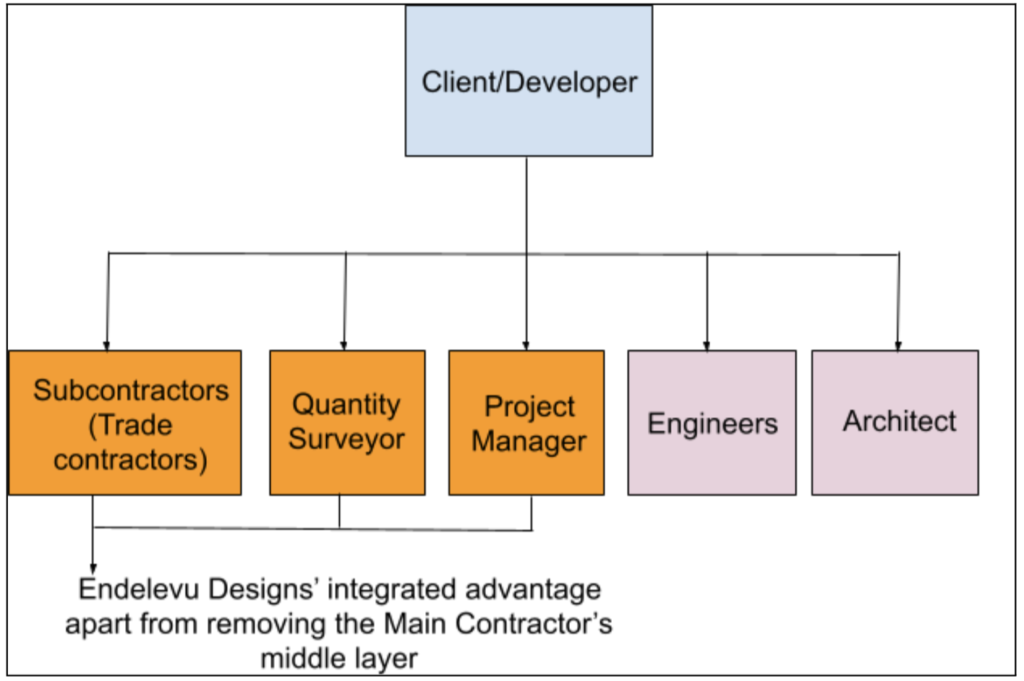
With Endelevu Designs’ integrated, lean and agile construction approach, you cut out a middle layer. Instead of employing a project manager, quantity surveyor, main contractor or an external construction management fi rm, the client/developer delivers the project with fewer stakeholders.

Using this construction scheme, the client/developer creates a main contracting capability in-house while also receiving the service of two professionals (project manager and quantity surveyor) at the same fee. This is what the route looks like